English
 Português
 Español
[…] The clarity on that 10th of February in 1922
Luisa Torreão*
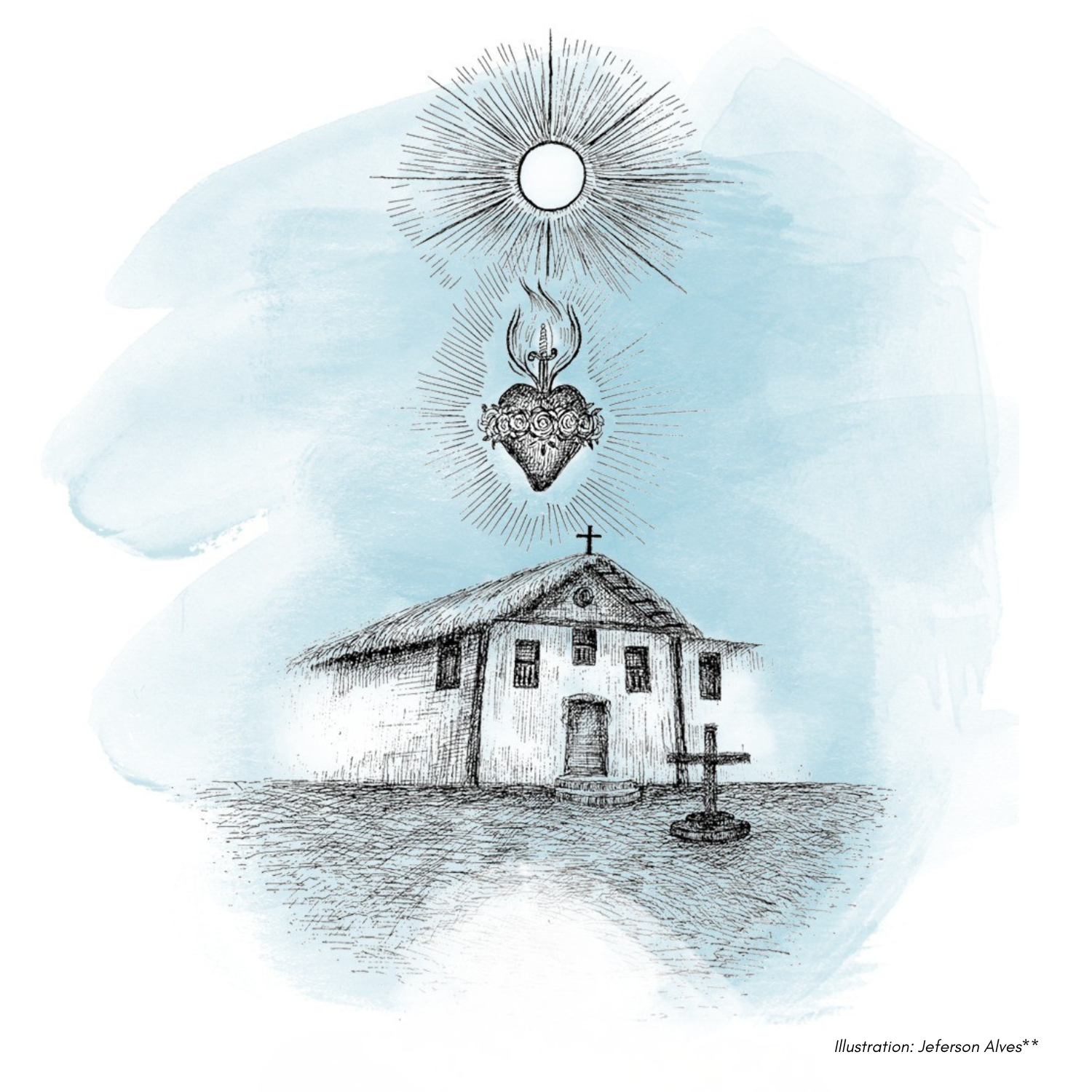
It wasn’t just any other Friday in the Gabriel da Costa home. The rays of that sunny morning brought the first signs that another child was about to be born, the eighth of the couple Prima Feliciana and Manoel Gabriel. The father and children, working or playing nearby, awaited the good news. In the couple’s bedroom, the mother’s midwife, comadre Pequena, and her mother-in-law, dona Vitalina, assisted in the arrival of the new child. Soon the shadow of the cashew tree that cooled the family home would no longer be cast across the yard.
At its highest point, the sun shone brightly on that February 10th, 1922, when, at the stroke of noon, José Gabriel da Costa was born. From far away, the bell tolled at the Nossa Senhora das Dores (Our Lady of Sorrows) Church, located in the district of Retiro — about five kilometers from the family’s property, in a rural area within the municipality of Coração de Maria, in Bahia. Many years later, in 1971, when he would return to visit his family again, José, already known as Mestre Gabriel — founder of the Beneficent Spiritist Center União do Vegetal —, revealed to his brother Antonio that he remembered the tolling of the bell that had taken place when he had been born.
His childhood wasn’t very different from that of his siblings or of the many other children in the region – little formal education in school, working in food cultivation, playing freely in the yard with what nature offered, and participating in the prayers and religious activities of a Christian family. Even so, his brothers later recognized that there was something different about José, who always seemed to excel at everything he did.
Birth Family
For us in the União do Vegetal, the door to get to know more about Mestre Gabriel’s birth family was opened when he visited Bahia in 1971, which would later lead to Antonio traveling to Porto Velho, making him more than just a blood brother [of the Mestre], but also a disciple. It was through Antonio Gabriel that the stories of the Mestres’s childhood arrived to us. And it was for the purposes of re-encountering him that the first brothers and sisters who started Núcleo Apuí, in Bahia, travelled to Coração de Maria and Pé de Serra, at the end of 1977, where they met Mestre Gabriel’s relatives.
On one of these visits, they received a true pearl: an interview with Dona Prima regarding the birth of her son, José, which was a painless childbirth, as she herself said at the time. At one point during the recording, there was laughter among those present, listening to the spontaneity of what happened. Below, we republish the transcription of this recording, received from Mestre Anchieta Torreão de Sá, one of those who participated in the trips to meet the Mestre’s family.
“When the boy was born, my late mother-in-law Vitalina said ‘oh, comadre Pequena, the boy has been born, come cut the umbilical cord.’ And so comadre Pequena went to cut the umbilical cord, and put him in a basin to bathe him. She washed him, scrubbed him with soap, scrubbed and scrubbed… and before they realized it, the bubbles very high inside the basin. Then I said ‘hey y’all’, don’t wash him like that, how can you wash a child that way?’ And so they tossed him onto the grass and poured water on him to rinse him off. And that’s how he ended up so well rinsed. I’ve never forgotten that” — Prima Feliciana da Costa
From his birth family, another person who was present during Mestre Gabriel’s visit in 1971 and later when the brothers of the União do Vegetal visited, was Maria de Lourdes da Costa, daughter of Dionízio, one of Mestre Gabriel’s older brothers. At the time she met her uncle she was still young, but she was very impressed with his firm and loving presence, which brought so much joy to the family. Today she is an associate of the Center and frequents Núcleo Coração de Maria, which is located on the land where José Gabriel was born. Below, we republish her interview during the Encontro of the Department of Memory and Communication (DMC) of the 4th Region, held in December 2025:
“When Mestre Gabriel arrived at our house, it was the most extraordinary thing that could have happened in our lives. He arrived suddenly and stayed only two days, but that was enough to explain what the União do Vegetal is and the benefit it brought to people. It was a very good moment. He really helped my dad, but not with money… he helped him spiritually. He said [to my dad] ‘I could help you a great deal if I had money here, but I don’t. If you go with me there [to Porto Velho], things also will change for you. There, I can help you much more than I can here, but here, I can only help you in a different way, so I will help you spiritually.’ And he helped. Our life changed a lot from this day forward. My dad never again passed through that kind of situation again. His life came improving more each day until he arrived to the place of living in peace, without difficulty. And Grandma Prima, whenever we spoke about Mestre Gabriel, she would tell stories about him when he was little, the games he would play, and I adored this- I was always pestering her [to tell me about him]. For me, meeting and knowing Mestre Gabriel was the best thing that ever happened in my life. He was an example in my life, and in our family’s life as well; and I’ll continue to feel this way until God takes me, when I one day have the condition to arrive close to him. I greatly honor this religion; you all have no idea.” — Maria de Lourdes, niece of Mestre Gabriel.
The family he formed and the União do Vegetal
Mestre Gabriel left Coração de Maria for Salvador when he was 18, where he worked and lived. In 1944, he left for Amazônia, where he began his travels to the seringais as a rubber-tapping soldier. In 1947, he married Raimunda Ferreira, known as Mestre Pequenina, in Porto Velho (RO). He met her at the hospital where he worked for a time as a nurse, after she brought in for treatment a girl who had been raised alongside her as a sister.
From this marriage, they built a family that served as the foundation for the creation of the União do Vegetal, which has the family as one of its fundamental principles. This is to be expected for someone who came from a family with Christian values, who experienced a close connection with God, the importance of work and the place of a man and a woman. Thus, he continued this way of being in his own life. Mestre Gabriel and M. Pequenina had 11 children. Three of them today continue the work of the União do Vegetal: brother Getúlio, Mestre Jair (the current General Representative Mestre) and Conselheira Jandira.
On July 22nd, 1961, in Seringal Sunta, in the presence of his family and the few people who were accompanying him, Mestre Gabriel declared the União do Vegetal to be created. It was through years of struggle and sacrifice. In January of 1965, he brought the recently created religion to Porto Velho as the first step of [the UDV’s] institutional structuring. Below, we showcase a part of an interview with Mestre Pequenina, recorded by the Department of Memory and Communication (DMC), in which she relates a little of her life experience with the Mestre:
“I was the first person he gave Vegetal to. And in this struggle, we had great suffering within the União do Vegetal. Today, I don’t regret it because he would always say that he was looking for a treasure and this treasure is the União do Vegetal. It is a treasure of true wealth, one that no one can steal. And each one of us, who has this jewel in our hands must have care so that this power does not slip away from us. Because the União do Vegetal is a wonderful path, a path of flowers and of happiness for humanity. I am seeing with my own eyes Mestre Gabriel’s words that the União do Vegetal would come to the world giving peace to humanity. And he is also seeing this from where he is. This is what he and I both want. Because I am a woman who knows perfectly well that I was born for him. My life’s destiny was already mapped out for him, and his for me. Mestre Gabriel is a man who while on Earth, I can only describe the kindness that he had. He was a peaceful, hardworking and friendly man.”— Mestre Pequenina
On this February 10th, a day of celebration, light, and joy, consecrated throughout our União, we pay homage to this man of humble origins, as well as to his family, who served as a foundation to offer us this treasure, the União do Vegetal. Long-live February 10th! Long-live Mestre Gabriel!
 –
–
*Luisa Torreão is a member of the Body of Counsel of Núcleo Apuí (Salvador-BA, 4th Region) and is adjunct-director of the Department of Memory and Communication of the General Directorate.
The following people collaborated in the production of this text:
Lucas Nahas – Director of the DMC-DG;
José de Anchieta Torreão de Sá – General Assistant Mestre;|
Jairo Santos and his book “Mestre Gabriel: Coração de Maria e sua família de origem”;
Ênio Cordeiro – Regional Coordinator of the DMC in the 4th Region and
Renato Hoisel Arléo – DMC helper in the 4th Region.
**The illustration by Jeferson Alves is part of the book “Mestre Gabriel: Coração de Maria e sua família de origem” authored by Jairo Santos.